





Patch Management: What It Is and Why It Matters for IT Teams and MSP
Patching goes beyond routine maintenance. It's your first line of defense against constantly evolving cyber threats.
Today, your team is managing more devices, facing an increasing number of vulnerabilities, and experiencing more pressure than ever before. Users are working from various locations, threats can emerge from anywhere, and you're expected to maintain security without missing a beat.
Unified patch management software, like LogMeIn Resolve, can help IT teams and MSPs keep pace with emerging threats and offer a strategic solution to protect sensitive data and systems. It combines intelligent automation with practical AI, transforming patching from a reactive scramble into a process that you can effectively control.
What Is Patch Management?
Patch management is a process used to identify which systems need updates, test those updates to make sure they won't break anything, and then deploy them across your infrastructure. This process helps close security vulnerabilities, fix bugs, enhance performance, and maintain compliance.
Strategic patch management differs from ad-hoc update deployment. A structured approach maintains system security while preserving operational continuity and minimizing business disruption.
Modern patch management covers a wide range of areas, including:
- Operating system updates for Windows, macOS, and Linux environments.
- Application patches for both enterprise and specialized software.
- Firmware updates for network infrastructure and IoT devices.
- Mobile device management for smartphones and tablets across hybrid workforce deployments.
This approach ensures that all aspects of a technology environment are kept up to date and secure.
There are three common types of patches that organizations manage:
- Security Patches: These time-sensitive patches address exploitable vulnerabilities in software and systems. The 2017 WannaCry ransomware attack affected over 200,000 computers across 150 countries. Each system had failed to apply a Microsoft security patch released months prior. This incident highlights the importance of timely security patch deployment.
- Bug Fix Patches: This type of patch helps resolve functional issues that impact system stability and user productivity without creating security exposure. Their main function is to improve operational reliability and user experience.
- Feature Patches: These patches introduce new capabilities or enhance existing functionality, enabling software evolution without requiring complete version upgrades. These updates often deliver productivity improvements and expanded business value.
Why is Patch Management Important for Modern IT Teams?
The statistics are striking. Approximately 60% of data breaches involve vulnerabilities where patches were already available, but not deployed. These aren't sophisticated zero-day exploits, they're preventable security failures that result from gaps in patch management processes.
The impact of inadequate patch management extends well beyond security incidents. Organizations face a compounding set of operational challenges that affect every level of IT operations.
Today's IT environment reveals significant stress points that show the hidden costs:
- 86% of IT professionals report that support backlogs force users into unsafe workarounds
- 84% of IT managers observe increasing technician burnout across their teams
- Organizations lose an average of 10.5 workdays annually due to preventable technical disruptions
- 73% of customers will switch to competitors after experiencing multiple poor digital interactions
When keeping IT systems up to date becomes overwhelming, the consequences escalate quickly. Security vulnerabilities remain exposed, system performance degrades, compliance requirements fall behind, and user productivity suffers.
Automated patch management transforms this dynamic by providing continuous protection without consuming IT resources. Modern solutions deliver audit trails for compliance verification, automated rollback capabilities for risk mitigation, and intelligent scheduling that maintains security while preserving business continuity. For SMBs and MSPs managing multiple client environments, automation has evolved from an operational advantage to an essential capability for sustainable growth.
Understanding The Patch Management Process
Effective patch management follows a structured, repeatable workflow that balances speed, stability, and security. Organizations must deploy patches quickly enough to mitigate emerging threats while exercising caution to avoid operational disruption. AI and automation capabilities enhance each phase of this process.
1. Discovery and Assessment
Efficient patch management starts with comprehensive asset discovery across all endpoints, such as laptops, mobile devices, servers, IoT equipment, and applications. This includes remote devices that may connect to the network intermittently or operate outside traditional corporate boundaries.
Maintaining visibility across hybrid work environments presents particular challenges, as employees access corporate resources from diverse locations and networks. Centralized dashboards and automated discovery tools provide real-time inventory management, ensuring complete visibility into every managed endpoint regardless of location or connection status.
2. Prioritization and Risk Scoring
Patch urgency varies significantly based on vulnerability severity, exploit likelihood, and business context. Critical security patches require immediate deployment, while lower-priority updates can be scheduled during planned maintenance windows.
IT teams utilize CVSS scores, vendor security advisories, and internal risk policies to assess patch criticality. Manual prioritization becomes unsustainable at scale. AI-driven systems analyze threat intelligence, active exploit data, and organizational context to automatically rank patches by actual risk, ensuring critical updates receive immediate attention.
3. Testing and Validation
Pre-deployment testing prevents patches from introducing operational disruptions or compatibility issues. This phase includes sandbox testing in isolated environments, phased rollouts to representative user groups, and compatibility validation across diverse system configurations.
Advanced platforms leverage AI-driven patch intelligence to simulate deployment outcomes and predict potential conflicts before production implementation, significantly reducing the risk of unintended consequences.
4. Deployment
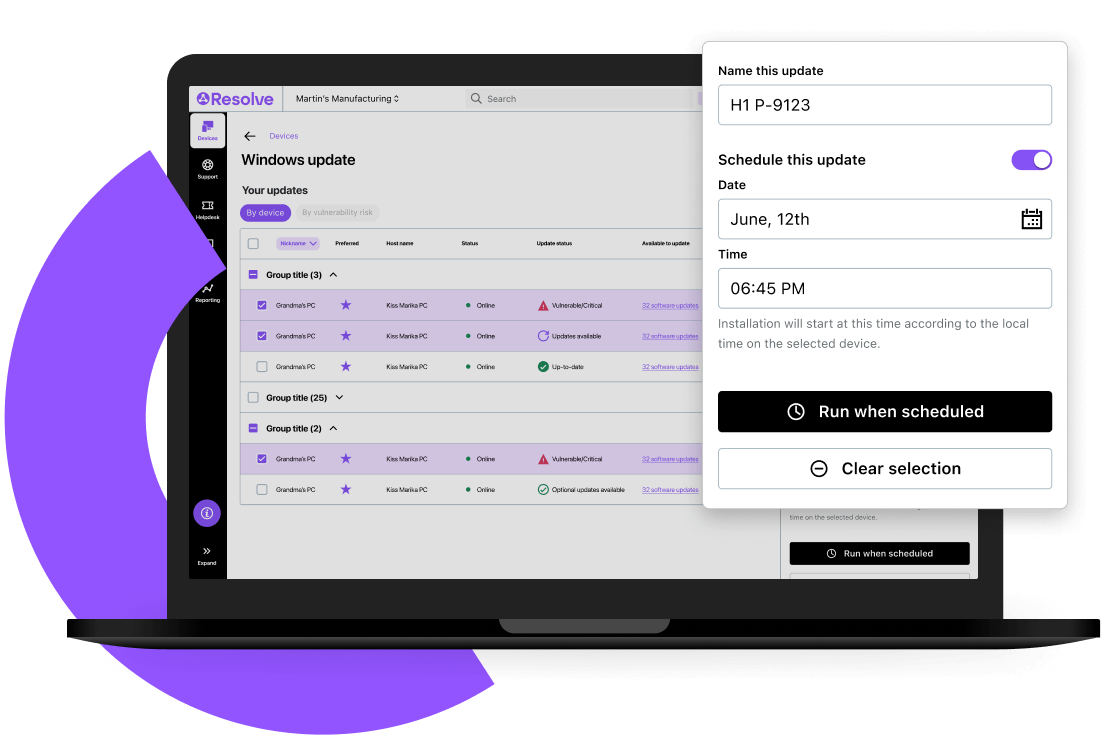
Deployment execution requires careful scheduling to minimize business disruption while maintaining security effectiveness. Considerations include maintenance windows, global time zones, user activity patterns, and system dependencies.
Modern automation tools intelligently queue patches based on business-critical workloads, deploy updates during optimal low-activity periods, and provide automated rollback capabilities if issues emerge. Organizations establish deployment policies while systems handle execution timing.
5. Verification
Post-deployment verification confirms successful patch installation and vulnerability remediation. This phase validates patch installation status, system functionality, and security improvement effectiveness.
Automated verification processes perform these checks at scale across all endpoints, flagging any systems requiring additional attention or remediation.
6. Reporting and Continuous Monitoring
Patch management requires ongoing visibility into deployment status, pending updates, and compliance metrics beyond initial deployment.
Comprehensive patch management platforms automatically generate audit-ready reports while continuously monitoring for new patches and emerging vulnerabilities. This documentation provides the accountability and compliance verification required for regulatory audits.
Support, secure, and manage endpoints with LogMeIn Resolve
- Mobile device management
- Remote monitoring and management
- Unattended remote access
- IT asset management
- Service management
- AI automation
Considerations for an Effective Patch Management Program
Successful patch management programs require careful consideration of multiple interconnected factors. Organizations must balance comprehensive visibility requirements, strategic timing that preserves productivity, compliance obligations, and operational continuity.
Modern automation and AI capabilities help organizations navigate these complex trade-offs, transforming previously difficult balancing acts into manageable operational processes.
System Inventory and Visibility:
Comprehensive asset visibility forms the foundation of effective patch management. Organizations can’t secure endpoints they can’t identify or monitor.
Real-time visibility requirements span all devices, operating systems, and applications regardless of physical location. Unified endpoint management platforms provide centralized dashboards displaying device health, patch status, and compliance metrics, eliminating the fragmentation of managing multiple point solutions.
Patch Prioritization and Risk Assessment
Patch prioritization depends on multiple factors: vulnerability severity, exploit likelihood, business impact, and deployment windows. As the volume of patches increases and the threat landscape evolves, manually assessing these factors becomes unmanageable.
AI-driven prioritization systems automatically analyze threat intelligence, vulnerability data, and organizational context to rank patches by actual risk. This ensures high-priority vulnerabilities receive immediate attention while lower-priority updates are scheduled appropriately.
Timing and Business Impact
Timing is everything. Strategic patch scheduling balances security requirements with operational continuity. Poorly timed deployments generate help desk volume and user frustration, while delayed patching extends vulnerability exposure.
Effective scheduling requires coordination with business stakeholders, accounting for global time zones, and understanding which systems depend on each other. Intelligent automation helps by analyzing when users are actually active and finding the best windows for deployment. Phased rollout capabilities let you validate patches with representative groups before rolling them out enterprise-wide.
Compliance and Documentation
Regulated industries, including healthcare, finance, and government, face strict documentation requirements. Standards such as SOC 2, HIPAA, and ISO 27001 require detailed patch logs and compliance verification.
Manual documentation processes are both error-prone and resource-intensive. Automated audit trails, session recording, granular permission controls, and compliance reporting provide the governance frameworks required for regulatory compliance while reducing administrative overhead.
What is Patch Management Software?
Patch management software transforms manual, resource-intensive processes into automated workflows that scale with organizational growth. These platforms centralize patch operations while automating time-consuming tasks.
The best solutions handle the full lifecycle: detecting available updates, assessing which patches matter most, deploying them safely, and verifying everything worked. LogMeIn Resolve takes this further by integrating AI capabilities that provide intelligent automation and unified visibility across distributed endpoint environments.
Automation and Scheduling
Automation capabilities enable faster, more consistent patch deployment with significantly fewer errors than manual processes. AI-driven scheduling optimizes deployment timing based on endpoint activity patterns, business requirements, and system dependencies.
This intelligent scheduling deploys critical security updates immediately while routing routine updates to off-peak hours. Automation frees IT teams from routine patch management tasks, enabling focus on strategic initiatives. Explore task automation strategies that extend beyond patching to transform IT operations.
Visibility and Reporting
Comprehensive visibility platforms provide centralized dashboards displaying real-time patch status, coverage rates, compliance metrics, and system health across all managed endpoints.
Having unified visibility eliminates information fragmentation, providing IT teams with complete insight into patch deployment status and pending updates. Automated reporting capabilities generate audit-ready documentation for compliance verification and stakeholder communication without manual compilation.
Remediation and Rollback
Even well-tested patches can occasionally introduce unexpected compatibility issues or system instabilities. Modern patch management software must include robust rollback and remediation capabilities to ensure system stability and business continuity when issues arise.
Automated rollback workflows enable IT teams to quickly revert problematic patches while preserving system uptime and minimizing user impact. These workflows detect anomalies, automatically initiate rollback procedures, and restore systems to their previous stable state, often before end users experience disruption.
LogMeIn Resolve incorporates intelligent rollback features alongside comprehensive sandbox testing capabilities. Our dual approach allows IT teams to validate updates in controlled test environments before production deployment, significantly reducing the risk of widespread issues. If a problem occurs, Resolve's automated remediation processes ensure rapid recovery, transforming potential hours of downtime into minutes of managed system restoration. Learn more about vulnerability remediation strategies that complement patch management workflows.
Patch Management as a Service (PMaaS)
Patch Management as a Service (PMaaS) addresses the resource and expertise challenges facing many organizations. PMaaS delivers managed patch management capabilities without requiring significant internal infrastructure investment.
This model particularly benefits resource-constrained organizations and MSPs managing multiple client environments. Modern PMaaS leverages AI automation, multi-tenant visibility dashboards, and Zero Trust security frameworks to deliver consistent patch management at scale while maintaining client control and visibility. MSPs looking to expand their service offerings can scale their MSP operations with automated patch management as a foundational service.
Considerations for an Effective Patch Management Program
Successful patch management programs require careful consideration of multiple interconnected factors. Organizations must balance comprehensive visibility requirements, strategic timing that preserves productivity, compliance obligations, and operational continuity.
Modern automation and AI capabilities help organizations navigate these complex trade-offs, transforming previously difficult balancing acts into manageable operational processes.
System Inventory and Visibility:
Comprehensive asset visibility forms the foundation of effective patch management. Organizations can’t secure endpoints they can’t identify or monitor.
Real-time visibility requirements span all devices, operating systems, and applications regardless of physical location. Unified endpoint management platforms provide centralized dashboards displaying device health, patch status, and compliance metrics, eliminating the fragmentation of managing multiple point solutions.
Patch Prioritization and Risk Assessment
Patch prioritization depends on multiple factors: vulnerability severity, exploit likelihood, business impact, and deployment windows. As the volume of patches increases and the threat landscape evolves, manually assessing these factors becomes unmanageable.
AI-driven prioritization systems automatically analyze threat intelligence, vulnerability data, and organizational context to rank patches by actual risk. This ensures high-priority vulnerabilities receive immediate attention while lower-priority updates are scheduled appropriately.
Timing and Business Impact
Timing is everything. Strategic patch scheduling balances security requirements with operational continuity. Poorly timed deployments generate help desk volume and user frustration, while delayed patching extends vulnerability exposure.
Effective scheduling requires coordination with business stakeholders, accounting for global time zones, and understanding which systems depend on each other. Intelligent automation helps by analyzing when users are actually active and finding the best windows for deployment. Phased rollout capabilities let you validate patches with representative groups before rolling them out enterprise-wide.
Compliance and Documentation
Regulated industries, including healthcare, finance, and government, face strict documentation requirements. Standards such as SOC 2, HIPAA, and ISO 27001 require detailed patch logs and compliance verification.
Manual documentation processes are both error-prone and resource-intensive. Automated audit trails, session recording, granular permission controls, and compliance reporting provide the governance frameworks required for regulatory compliance while reducing administrative overhead.
What is Patch Management Software?
Patch management software transforms manual, resource-intensive processes into automated workflows that scale with organizational growth. These platforms centralize patch operations while automating time-consuming tasks.
The best solutions handle the full lifecycle: detecting available updates, assessing which patches matter most, deploying them safely, and verifying everything worked. LogMeIn Resolve takes this further by integrating AI capabilities that provide intelligent automation and unified visibility across distributed endpoint environments.
Automation and Scheduling
Automation capabilities enable faster, more consistent patch deployment with significantly fewer errors than manual processes. AI-driven scheduling optimizes deployment timing based on endpoint activity patterns, business requirements, and system dependencies.
This intelligent scheduling deploys critical security updates immediately while routing routine updates to off-peak hours. Automation frees IT teams from routine patch management tasks, enabling focus on strategic initiatives. Explore task automation strategies that extend beyond patching to transform IT operations.
Visibility and Reporting
Comprehensive visibility platforms provide centralized dashboards displaying real-time patch status, coverage rates, compliance metrics, and system health across all managed endpoints.
Having unified visibility eliminates information fragmentation, providing IT teams with complete insight into patch deployment status and pending updates. Automated reporting capabilities generate audit-ready documentation for compliance verification and stakeholder communication without manual compilation.
Remediation and Rollback
Even well-tested patches can occasionally introduce unexpected compatibility issues or system instabilities. Modern patch management software must include robust rollback and remediation capabilities to ensure system stability and business continuity when issues arise.
Automated rollback workflows enable IT teams to quickly revert problematic patches while preserving system uptime and minimizing user impact. These workflows detect anomalies, automatically initiate rollback procedures, and restore systems to their previous stable state, often before end users experience disruption.
LogMeIn Resolve incorporates intelligent rollback features alongside comprehensive sandbox testing capabilities. Our dual approach allows IT teams to validate updates in controlled test environments before production deployment, significantly reducing the risk of widespread issues. If a problem occurs, Resolve's automated remediation processes ensure rapid recovery, transforming potential hours of downtime into minutes of managed system restoration. Learn more about vulnerability remediation strategies that complement patch management workflows.
Patch Management as a Service (PMaaS)
Patch Management as a Service (PMaaS) addresses the resource and expertise challenges facing many organizations. PMaaS delivers managed patch management capabilities without requiring significant internal infrastructure investment.
This model particularly benefits resource-constrained organizations and MSPs managing multiple client environments. Modern PMaaS leverages AI automation, multi-tenant visibility dashboards, and Zero Trust security frameworks to deliver consistent patch management at scale while maintaining client control and visibility. MSPs looking to expand their service offerings can scale their MSP operations with automated patch management as a foundational service.
Key Benefits of Patch Management
Strategic patch management isn’t just about checking off compliance boxes, it drives tangible business outcomes. When organizations commit to comprehensive patch management programs, they see benefits multiply across security, operations, compliance, and team productivity.
These advantages create sustainable competitive differentiation in an increasingly complex IT landscape.
Improved Security and Risk Reduction
The majority of cyberattacks exploit known vulnerabilities for which patches are readily available. Major incidents such as the Equifax breach were entirely preventable through timely patch deployment.
Consistent, rapid patching closes vulnerability windows before exploitation occurs. Organizations with mature patch management programs experience significantly fewer successful attacks and data breaches, reducing incident costs, operational downtime, and reputational damage from preventable security failures. Understanding broader cybersecurity threats helps organizations develop comprehensive defense strategies where patch management serves as a foundational control.
Operational Continuity
Patches do more than fix security holes. They keep systems stable and running smoothly. Regular updates prevent crashes, resolve compatibility problems, and stop performance from degrading over time.
Consistent patching reduces IT incident frequency and severity, enabling more predictable operations and improved user experiences. This operational stability proves particularly valuable for organizations supporting remote and hybrid workforces, where system reliability directly impacts productivity regardless of employee location.
Compliance and Governance
Regulatory frameworks, including SOC 2, HIPAA, PCI DSS, and ISO 27001 require organizations to demonstrate consistent patching practices and vulnerability management capabilities.
Meeting regulatory requirements demands comprehensive documentation and audit trails.
Automated compliance reporting transforms a manual, time-intensive process into streamlined verification. IT teams can demonstrate security controls to auditors without spending hours compiling evidence, while reducing exposure to penalties that result from documentation gaps or compliance failures.
Efficiency and Cost Savings
Automated patch management generates substantial cost savings through reduced manual workload, improved technician efficiency, and minimized business impact from security incidents and system failures.
Streamlined workflows enable IT teams to support larger device populations without proportional staffing increases. Organizations leveraging unified patch management platforms often achieve 10x productivity improvements while reducing overall IT operational costs.
Patch Management Best Practices
Implementing proven patch management best practices transforms reactive maintenance into proactive risk management that enhances security, improves operational efficiency, and builds user confidence.
These strategies have demonstrated effectiveness across IT organizations of all sizes, helping teams transition from reactive incident response to proactive security operations with measurable improvements in security posture, operational reliability, user satisfaction, and cost efficiency.
Centralize Patch Control
Consolidating patch management activities into unified platforms reduces tool sprawl, eliminates visibility gaps, and creates consistent processes across all managed endpoints.
Centralized control enables uniform policy application, more effective compliance tracking, and faster threat response without coordinating across multiple tools and interfaces.
LogMeIn Resolve provides this unified visibility while reducing the complexity and cost associated with managing multiple point solutions.
Automate Where Possible
Automation reduces manual effort, eliminates human errors, and ensures consistent patch deployment across diverse IT environments.
AI-driven automation detects vulnerabilities, prioritizes patches based on risk and business impact, and deploys updates during optimal maintenance windows. Platforms like Resolve leverage practical AI to predict compatibility issues, optimize deployment schedules, and handle routine tasks, freeing technicians to focus on strategic initiatives.
Segment Deployment
Phased rollouts to representative user groups allow IT teams to validate patch compatibility and performance before enterprise-wide deployment, minimizing the risk of widespread disruption.
By catching issues early in controlled environments, organizations prevent widespread disruption. LogMeIn Resolve offers sophisticated segmentation options, by device type, user role, geography, or business criticality, so you can move quickly where it's safe and proceed carefully where it matters most.
Track Compliance Metrics
Comprehensive metrics tracking ensures accountability while simplifying regulatory audits and risk assessments. Effective tracking includes patch deployment status, coverage rates, compliance percentages, and remediation timelines across all managed endpoints.
Automated reporting tools generate audit-ready documentation that reduces administrative burden while providing stakeholders with clear visibility into security improvements and operational performance.
Integrate with ITSM
Integrating patch management workflows with IT Service Management platforms creates seamless visibility and communication across IT operations teams.
This integration enables coordinated change management, automated ticket creation for patch-related issues, and improved communication with end users about scheduled maintenance activities. Leading solutions integrate natively with platforms like ServiceNow to align patching activities with broader IT service delivery processes.
Prioritize User Experience
User productivity matters as much as security when planning patch deployments. The goal is to keep systems protected without disrupting work or creating frustration. Smart scheduling makes this possible. Updates happen during off-peak hours, users get advance notice about system changes, and deployment options flex to accommodate different work patterns. AI-powered scheduling takes this further by analyzing actual user activity patterns to find maintenance windows that maintain security while minimizing disruption.
Leverage Patch Management as a Service (PMaaS)
For organizations without deep internal resources or specialized expertise, PMaaS offers a practical alternative. The managed approach handles automation, monitoring, and deployment, delivering consistent patch coverage without requiring significant internal investment or infrastructure buildout.
Today's PMaaS platforms leverage AI-powered automation and multi-tenant visibility while integrating Zero Trust security frameworks. Organizations get enterprise-grade capabilities at costs that scale with their actual needs.
When security guides every patch management decision, the payoff is measurable. Organizations build resilient IT operations that adapt to evolving threats without sacrificing business momentum. These best practices, applied systematically, turn what was once an operational burden into a strategic advantage.
How LogMeIn Resolve Helps IT Teams Simplify Patch Management
LogMeIn Resolve delivers an automated patch management solution with measurable business value for IT professionals and MSPs operating at scale. Unified dashboards ensure no managed endpoints are overlooked or underprotected. Built-in compliance reporting automatically generates audit-ready documentation that helps organizations meet SOC 2, HIPAA, and ISO requirements without additional administrative overhead.
LogMeIn’s patch management software delivers measurable efficiency improvements that provide IT teams with a true impact advantage across security effectiveness, system uptime, and operational cost management.
The Future of Patch Management: Trends and Emerging Technologies
Emerging technologies are transforming how organizations approach vulnerability management and system maintenance. As cyber threats intensify and attack surfaces expand, forward-thinking organizations that invest in patch management can set themselves apart from the competition with bolstered security, enhanced reliability, and optimized resource utilization.
LogMeIn Resolve is built for this future. Our investment in AI-driven automation, predictive maintenance, and autonomous operations creates a foundation that adapts to evolving business requirements and technological changes. These capabilities enable IT teams to anticipate potential issues before they impact operations, automatically prioritize patches based on real-time threat intelligence, and deploy updates with minimal human intervention while maintaining comprehensive oversight and control.
Frequently Asked Questions About Patch Management
What Is the Purpose of Patching?
What Types of Patches Are There?
How Can Automation Improve the Patch Management Process?
How Often Should Patch Management Be Performed?
What's the Difference Between Manual and Automated Patch Management?
Who Is Responsible For Patch Management in an Organization?
How Does Patch Management Differ for MSPs vs. Internal IT Teams?
How Does Patch Management Fit Into Unified Endpoint Management (UEM)?