





Related Posts

How to easily migrate your MDM Apple Devices to LogMeIn Resolve MDM

MAM vs. MDM: Choosing the Best Mobile Management Solution for Your Organization

In today's hybrid and remote work environments, IT teams face an unprecedented challenge: managing and securing a sprawling ecosystem of devices, applications, and users across multiple locations and platforms. Unified endpoint management (UEM) has emerged as the critical solution that enables organizations to monitor, manage, and secure all endpoint devices, through a single, centralized platform, regardless of operating system or location. These UEMs need to be able to handle a range of devices, including laptops, smartphones, and even IoT devices.
This challenge has intensified what we call the "IT Complexity Crunch" – a perfect storm of fragmented systems, expanding threat surfaces, and mounting resource constraints that's pushing IT departments to their breaking point. IT professionals are constantly reporting that support backlogs force users into unsafe workarounds, while most IT managers are witnessing significant technician burnout. The result? Organizations lose an average of 10.5 workdays annually due to minor tech disruptions, and 73% of customers will switch to competitors after experiencing multiple bad digital experiences.
For modern IT teams operating under the "do more with less" mandate, unified endpoint management software isn't just a nice-to-have. Rather, it's become essential for survival and success in an increasingly complex digital landscape.
Unified endpoint management (UEM) is a comprehensive platform that consolidates the management, monitoring, and security of all organizational endpoints into a single console. Unlike traditional approaches that require separate tools for different device types or operating systems, UEM provides a holistic view and control mechanism that spans desktops, laptops, smartphones, tablets, and even emerging technologies like IoT devices.
What sets modern UEM apart from legacy solutions is its integration of AI-driven automation and zero-trust security principles, enabling IT teams to shift from reactive firefighting to proactive, predictive operations. While older mobile device management (MDM) and enterprise mobility management (EMM) solutions addressed specific segments of device management, UEM bridges all gaps to create truly unified IT operations.
The journey to unified endpoint management (UEM) represents a natural evolution from earlier, more limited approaches. Mobile device management (MDM) initially focused solely on securing and managing mobile devices, while EMM expanded to include application and content management. UEM represents the maturation of these concepts, incorporating lessons learned from hybrid work adoption and the need for platform-agnostic management that can handle the full spectrum of modern endpoint complexity.
The shift to distributed work models has fundamentally changed how organizations operate, creating new challenges that traditional IT management approaches simply cannot address effectively. Remote and hybrid workforces demand seamless access to corporate resources from virtually any device, anywhere, at any time, all while maintaining enterprise-grade security and compliance standards.
UEM helps IT leaders navigate the IT Complexity Crunch by providing centralized control and intelligent automation that reduces manual intervention, minimizes human error, and enables proactive problem resolution. Rather than juggling multiple management consoles and struggling with integration challenges, IT teams can focus on strategic initiatives that drive business value while maintaining the security and reliability their organizations depend on.
Modern IT environments suffer from several critical pain points that UEM directly addresses. Device sprawl creates visibility gaps and inconsistent security postures across the organization. Manual patch management processes leave vulnerabilities exposed for extended periods, while fragmented management tools create operational silos that slow response times and increase the likelihood of configuration errors. These challenges compound in hybrid work environments where traditional network perimeters no longer exist, making endpoint security more critical than ever.
UEM implementation delivers measurable improvements across multiple dimensions of IT operations. Enhanced security comes through consistent policy enforcement and real-time threat detection across all managed endpoints. Automation capabilities reduce manual workload while improving accuracy and response times. Centralized control provides unprecedented visibility into device health, usage patterns, and security posture, enabling data-driven decision-making. Most importantly, UEM solutions deliver significant cost savings by consolidating tools, reducing licensing complexity, and improving operational efficiency.
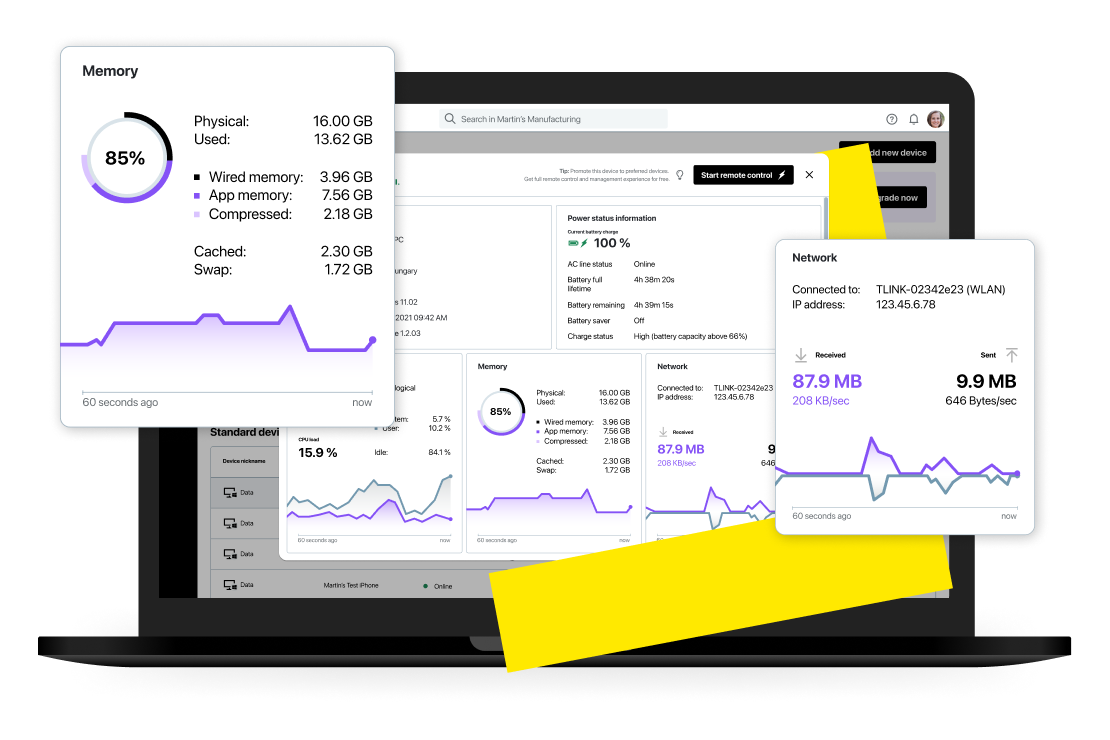
Leading UEM platforms provide a comprehensive suite of capabilities designed to address the full lifecycle of endpoint management. These solutions integrate traditionally separate functions, such as device provisioning, application deployment, security enforcement, and compliance monitoring, into a cohesive platform that scales with organizational needs. Modern UEM tools also incorporate advanced features like predictive analytics, automated remediation, and intelligent policy adjustment based on user behavior and risk assessment.
A key differentiator for organizations evaluating UEM solutions is integrated data protection and business continuity capabilities. LogMeIn's Resolve platform, for example, includes business disaster recovery functionality through its Acronis integration. This approach provides comprehensive endpoint protection that extends beyond traditional management to include backup, recovery, and cyber protection. Innovative integrations like these address The Complexity Crunch with unified solutions, rather than disparate tools.
Explore how these features work together to form a seamless solution:
UEM architecture typically consists of several key components working together to provide comprehensive endpoint management capabilities:
Organizations can choose between cloud-based and on-premise UEM deployment models based on their specific requirements and constraints. Cloud-based UEM solutions offer rapid deployment, automatic updates, and scalability advantages, making them particularly attractive for organizations with limited IT infrastructure or those supporting highly distributed workforces.
On-premise solutions provide greater control over data and infrastructure while potentially offering better performance for organizations with significant local IT resources and strict data sovereignty requirements.
Automation serves as the cornerstone of effective UEM implementation, enabling consistent policy enforcement across thousands of endpoints without manual intervention. Modern UEM platforms use rule-based automation and increasingly sophisticated AI-driven decision-making to automatically respond to policy violations, security threats, and performance issues. This automation capability not only improves response times but also reduces the likelihood of human error in critical management tasks.
UEM tools fundamentally strengthen endpoint security by implementing zero-trust principles at scale, ensuring that every device, user, and application is continuously verified and validated before accessing corporate resources. This approach eliminates the traditional assumption that devices within the network perimeter are inherently trustworthy, instead requiring continuous authentication and authorization for all access attempts. Advanced UEM platforms integrate with threat intelligence feeds and behavioral analytics to provide dynamic risk assessment and automated threat response capabilities.
The security benefits of UEM extend beyond traditional endpoint protection to include data loss prevention, compliance monitoring, and incident response coordination. By providing centralized visibility into all endpoint activities, UEM solutions enable security teams to quickly identify and contain potential threats while maintaining detailed audit trails for compliance and forensic analysis. This comprehensive approach to endpoint security is essential in today's threat landscape, where attackers increasingly target endpoints as the path of least resistance into corporate networks.
Organizations across industries are leveraging UEM solutions to address a wide range of operational challenges and strategic initiatives. From supporting hybrid workforce models to ensuring regulatory compliance, UEM platforms provide the flexibility and control necessary to adapt to changing business requirements while maintaining security and operational efficiency. The most successful UEM implementations focus on specific use cases that deliver measurable business value while building the foundation for future expansion and enhancement.
While understanding UEM concepts and capabilities is important, the real value lies in how these solutions perform in actual business environments under real-world pressures. Modern UEM platforms must deliver on their promises while integrating seamlessly with existing infrastructure and adapting to changing organizational needs. The most effective solutions combine proven reliability with innovative features that address both current challenges and future requirements.
LogMeIn Resolve exemplifies this modern approach to UEM by combining two decades of proven reliability with cutting-edge AI capabilities and comprehensive security integration. Built specifically for IT professionals and MSPs who need to deliver exceptional service while operating under resource constraints, Resolve provides a practical example of how advanced UEM platforms can address the IT Complexity Crunch through intelligent automation and unified management capabilities.
Resolve's UEM capabilities represent a future-ready foundation for AI-driven, autonomous endpoint management that evolves with organizational needs. The platform's ability to eliminate siloed security while providing comprehensive visibility and control positions organizations at the forefront of the next phase of IT operations. Organizations interested in experiencing these capabilities firsthand can try LogMeIn Resolve for free to evaluate how modern UEM solutions perform in their specific environments.
Selecting the right UEM solution requires carefully evaluating organizational requirements, existing infrastructure, and strategic objectives. The most successful implementations begin with a clear understanding of current pain points and desired outcomes, followed by systematic evaluation of available solutions against specific criteria.
The future of UEM is being shaped by emerging technologies and evolving organizational needs that promise to transform how IT teams manage and secure endpoint environments. As the IT Complexity Crunch continues to intensify with new device types, emerging threats, and increasing user expectations, UEM platforms must evolve to provide more intelligent, autonomous, and predictive capabilities that can adapt to changing conditions without constant human intervention.
Artificial intelligence is rapidly transforming UEM capabilities by enabling more sophisticated automation and decision-making processes. AI-powered UEM platforms can analyze vast amounts of endpoint data to identify patterns, predict potential issues, and automatically implement corrective actions before problems impact users. This evolution toward autonomous endpoint management promises to significantly reduce the administrative burden on IT teams while improving service quality and security posture.
Predictive analytics capabilities are enabling unified enpoint platforms to shift from reactive problem-solving to proactive maintenance and optimization. By analyzing historical performance data, usage patterns, and environmental factors, UEM solutions can predict when devices are likely to experience issues and automatically schedule preventive maintenance activities. This approach reduces downtime, improves user satisfaction, and optimizes hardware lifecycle management.
Self-healing endpoint capabilities represent the next evolution in autonomous IT management, enabling devices to automatically detect, diagnose, and resolve common problems without human intervention. These systems leverage machine learning algorithms and extensive knowledge bases to implement appropriate remediation actions while escalating complex issues to human technicians when necessary. Self-healing endpoints promise to dramatically reduce help desk tickets while improving overall system reliability.
The integration of UEM platforms with comprehensive zero-trust security frameworks is creating more robust and adaptive security architectures. These integrated solutions provide continuous authentication and authorization for all endpoint activities while dynamically adjusting access permissions based on real-time risk assessments. This evolution ensures that security controls keep pace with changing threat landscapes and user behavior patterns.
Organizations that embrace these emerging capabilities today will be better positioned to navigate future challenges while maintaining competitive advantages through superior IT operations and security. Recent advancements in UEM demonstrate the rapid pace of innovation in this space and the importance of selecting platforms that can evolve with organizational needs and technological developments.
What Does UEM Stand For?
Is UEM the same as MDM or EMM?
What are the differences between MDM vs. EMM vs. UEM?
Does UEM support multiple operating systems?
Does UEM help with compliance requirements like GDPR or HIPAA?
How is UEM different from endpoint security?
How do I choose the right UEM tool?
Will UEM replace traditional device management?


Enhance endpoint management with automated security, efficient patching, and comprehensive IT oversight.