





Related Posts

What is IT automation and why you need it yesterday

Automation Strategies for Lean MSPs: Scaling with Fewer Hands-on Deck

IT automation leverages software and technology to take over routine IT work. When it's done right, automation quietly handles repetitive tasks in the background so your team can focus on higher-value projects. It can cover everything from patching and monitoring to ticket resolution and security response, and it's becoming the backbone of how modern IT teams manage increasingly complex environments. When you shift from a reactive to a proactive approach with automated operations, you give your team room to breathe and plan. Automation becomes the foundation for consistent, high-performance IT that users can rely on.
As the work landscape has changed from managing employees in an office to remote work, where devices are scattered across homes and public Wi-Fi, legacy automation is no longer enough. Every laptop, phone, or server that exists in the wild is now a possible way into your network. At the same time, budgets are tight, ticket volumes are rising, and users expect everything to “just work,” no matter where they are or what they are using.
Built on two decades of reliability and standing at the forefront of AI-powered IT management, LogMeIn’s automation approach is designed to help IT teams manage complexity without losing control. The goal is to resolve today’s problems while creating future-proof solutions that scale over time: better technician productivity, better user experiences, stronger security, and more efficient spend.
Corporate IT teams are operating in an environment where specialized talent is scarce and expensive, while user expectations for convenience and responsiveness continue to rise. Endpoints live everywhere, and every one of them needs to be patched, secured, and supported. Tickets come in from multiple channels, at all hours, from users who expect fast, consumer-grade experiences.
Additionally, hiring and retaining skilled IT talent is harder and more expensive than ever. The people you do have are often stretched thin, trying to keep systems stable, defend against evolving threats, and roll out new tools, all at the same time.
In this environment, simply working harder is not enough. The teams that stay ahead are the ones that use automation to extend what their people can do, rather than relying on manual effort alone.
Automation and using AI effectively transforms IT from a cost center to a value driver. By standardizing workflows, automation ensures that tasks like patching or onboarding happen with precision every time, eliminating the "Frankenstein friction" of stitched-together point solutions. Automation bridges the gap between human speed limits and the scale required by modern infrastructure. The result is higher uptime, reduced support backlogs, and an IT team that has the bandwidth to focus on strategic initiatives rather than repetitive maintenance.
At its core, IT automation is about visibility, predictability, and execution. It functions by defining a set of rules or instructions that a system follows to perform a task without human oversight.
To understand the mechanics, we can break automation down into four key components:
LogMeIn approaches these mechanics with a focus on running in a known, secure predictive state. By combining real-time visibility with automated execution, IT teams can detect anomalies and anticipate patterns before they disrupt the business.
IT automation can be applied at multiple layers of your organization's technology stack, from the infrastructure that powers your operations to the business processes that define how work gets done. Understanding these different types helps you prioritize automation opportunities and align them with your organization's specific needs and goals.
The value of IT automation goes beyond “saving time.” Done well, it improves reliability, security, team morale, and the ability of IT to support growth. For MSPs, it also creates scalable service models and more consistent results across client environments.
Explore how these features work together to form a seamless solution:
IT automation delivers a lot of upside, but it is not a magic switch. Getting real value from it requires thoughtful planning, good governance, and a realistic understanding of the obstacles you may run into.
Seeing how automation works in real scenarios makes it easier to spot similar opportunities in your own environment. Here are some common use cases that many IT teams and MSPs start with.
Many tools on the market promise IT automation. Some focus on ITSM, others on remote monitoring and management, configuration management, or security orchestration. The challenge is choosing tools that fit together and support your goals.
When evaluating options, it helps to look at:
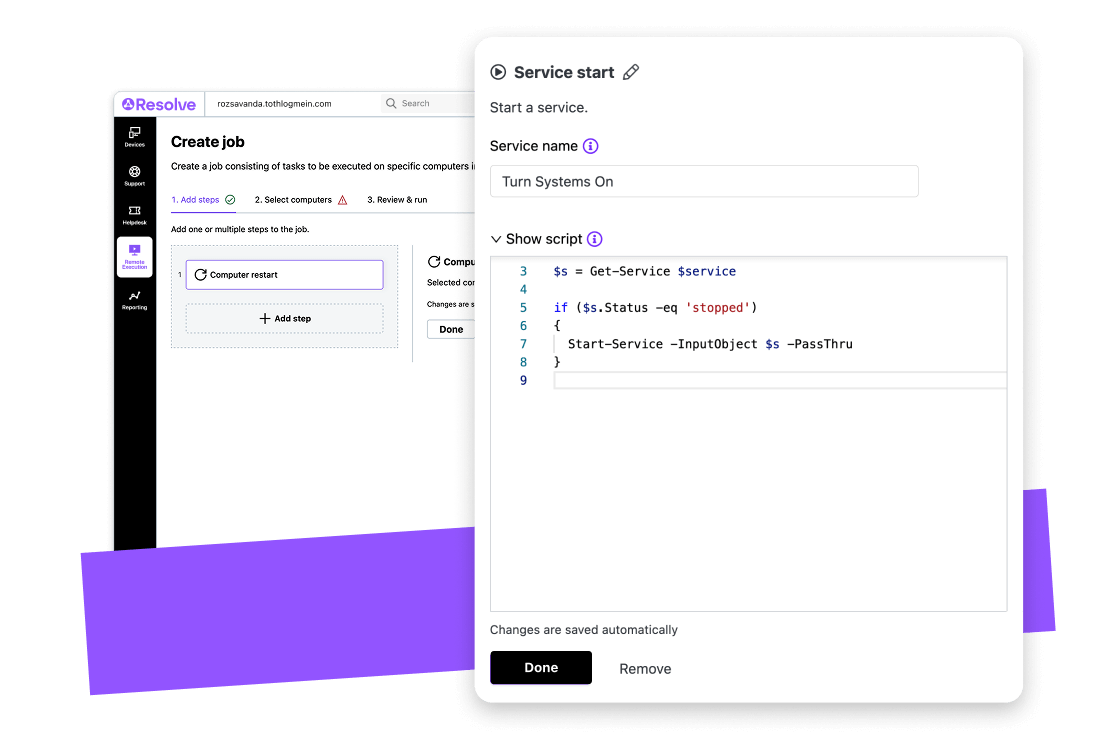
Platforms that unify multiple capabilities are often easier to manage than a collection of point tools. LogMeIn Resolve is designed this way. It combines: automation software, RMM capabilities, automated patch management, endpoint protection, and Zero Trust security into a single, streamlined management console. That unified approach reduces the friction of managing many separate systems and helps teams get more value from automation faster.
A good automation program starts with a clear picture of where you are today and where automation can do the most good. Rather than trying to automate everything at once, it's more effective to start small, learn, and expand.
Here's what a practical framework looks like:
Research suggests that organizations that automate a significant portion of their routine IT tasks see improvements in uptime, user satisfaction, and team morale. The key is to treat automation as an ongoing capability that evolves with your environment, not as a one-time project.
LogMeIn Resolve is built to help modern IT teams and MSPs apply automation in ways that are secure, reliable, and practical. Instead of forcing you to assemble your own automation stack from many tools, Resolve offers a connected set of capabilities in one platform.
Key strengths include:
All of this is grounded in three core pillars:
Together, these pillars help IT teams build better performance across support, security, and operations without burning out their staff.
IT automation is moving from “nice to have” to “how work gets done.” As AI improves and infrastructures become more distributed, automation will play an even larger role in how IT teams operate day to day.
LogMeIn is investing heavily in this future, dedicating a significant portion of R&D to AI and automation so that Resolve can keep pace with emerging needs while maintaining the stability enterprise customers expect.
Self-healing systems will increasingly be able to identify, diagnose, and fix certain problems on their own. They will draw on patterns learned from many similar incidents and apply proven fixes automatically, only escalating when something unusual appears.
Service desks will continue to evolve from simple ticket intake to intelligent, conversational experiences. AI will be able to understand a user’s request, pull context from previous interactions, and either deliver a solution on the spot or drive an automated workflow that handles the request behind the scenes.
As workloads spread across cloud services, on-premises systems, and edge locations, automation will need to work across all of them. Future platforms will manage and secure this mix from a single control plane, giving IT teams a unified view of what is happening and where.
AIOps will help IT teams make sense of the huge volume of operational data generated every day. By correlating signals across tools, AIOps platforms will highlight what matters, predict where issues are likely to appear, and recommend or initiate corrective action.
Hyperautomation combines AI, robotic process automation, and workflow tools to automate entire business processes end to end. As this matures, IT will be central to designing, governing, and maintaining these flows, and platforms like LogMeIn Resolve will be key building blocks in that ecosystem.
IT environments are growing more complex by the day. Devices, apps, and security risks will continue to grow. Teams that lean into automation now will be better prepared for whatever comes next.
LogMeIn Resolve gives you a practical way to start or accelerate that journey. Built on two decades of reliability and standing at the forefront of AI-powered IT management, LogMeIn’s automation approach is designed to help IT teams manage complexity without losing control. The goal is to resolve today’s problems while creating future-proof solutions that scale over time.
Try LogMeIn Resolve for free and see how automation can help you move from constant firefighting to a more strategic, sustainable way of running IT.
How Does IT Automation Work?
How Does IT Automation Differ From Traditional IT Management?
What Types of IT Tasks Can Be Automated?
How Can LogMeIn Resolve Help Automate IT Operations?
What Are the Benefits of IT Automation for IT Teams?


Improve productivity and save time to focus on the important things.